
I.G.H.A. / HorseAid's Bureau of Land Management News

General Information - BLM Mustangs & Burros
(taken from BLM literature)
The Bureau of Land Management (Department of the Interior) and the U.S. Forest Service (Department of Agriculture) are responsible for the management and protection of wild horses and burros on public lands. Federal protection and a scarcity of natural predators, results in thriving herds that increase in population each year.
The number of animals using the range must be controlled to protect the resources from improper foraging and to maintain healthy thriving herds.
Livestock are controlled through permits and leases which limit the time and number of domestic animals on the land. Wildlife populations are managed bt state wildlife agencies. The health and welfare of wild horse and burro herds are maintained by balancing the number of animals with the other resources.
Excess wild horses and burros are removed from the range to protect and maintain healthy herds and habitat of wild free-roaming horses and burros for future generations to enjoy. These excess animals are offered for adoption to qualified people through the Adopt-A-Horse-or-Burro Program. Since 1973, BLM has used this popular program to place over 130,000 wild horses and burros in private care. Adopters receive a living symbol of the "historic and pioneer spirit of the West."
A wild horse or burro is an unbranded, unclaimed, free-roaming horse or burro found on BLM or U.S. Forest Service administered land in the western United States. Wild horses and burros are descendants of animals released by or escaped from Spanish explorers, ranchers, miners, soldiers, or Native Americans.
All wild horses and burros are protected by the Wild Free Roaming Horse and Burro Act of 1971. Even though a wild horse or burro is removed from the public lands it remains a federally protected wild animal until it is adopted and the federal government has transferred title to the adopter.
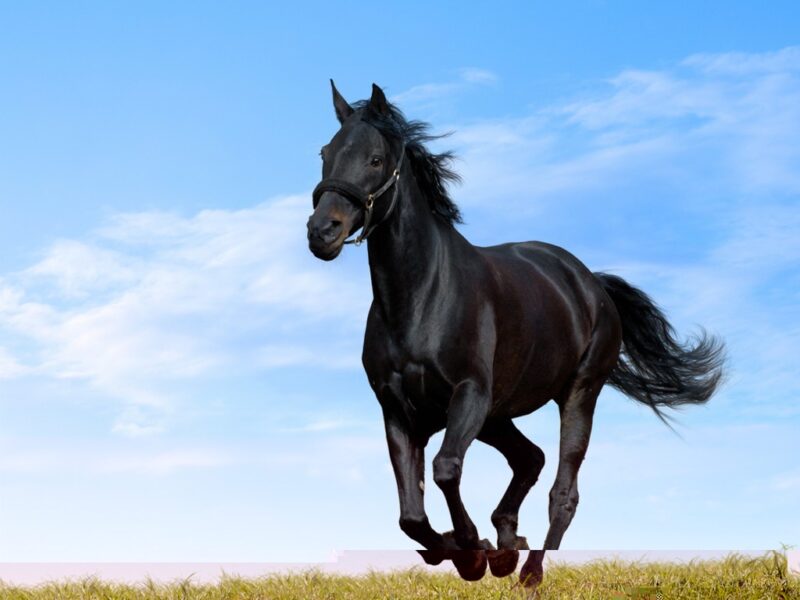
Wild horses are of no particular breed, but some exhibit characteristics associated with specific breeds. A typical wild horse stands about 14 to 15 hands (56-60") and weighs about 900 to 1,100 pounds. Horses are generally solid in color and predominantly sorrels, bays, or browns, although all colors occur. Horses offered for adoption range from several months to 9 years of age. Most horses are five years or younger. Mares with unweaned foals, when available, are adopted together. Geldings are available at special locations.
The adoption fee for each wild horse is $ 125 and for each wild burro the fee is $ 75. There is no adoption fee for unweaned foals if they are adopted with their mother. The adoption fee defrays the costs of gathers, medical treatment, transportation, and adoptions. Prison training programs often charge a fee which reimburses the state for gentling or saddle training the animal. Adopters are responsible for all costs following the adoption including recapture of escaped animals. Adoption fees are nonrefundable.
A qualified person can adopt up to four wild horses or burros within a twelve month period. The BLM can approve the adoption of more than four animals if the adopter can prove they have the facilities and the financial ability to humanely care for all animals. However, an adopter may not receive title to more than four animals within a twelve month period.
You must be at least 18 years old, be a resident of the United States, and have no convictions for inhumane treatment of animals. You must also have, or have arranged for, adequate facilities and the financial means to provide for the number of animals adopted. An individual to adopt an animal who has expressed an intent to commercially exploit the wild nature of a wild horse or burro may not adopt a wild horse or burro.
Parents or guardians may adopt, then allow younger family members to care for the animal. Many young people have cared for and trained wild horses or burros as projects for 4-H, Future Farmers of America, county fairs, and Scouts.
Newly adopted wild horses or burros must be kept in an enclosed corral with a minimum area of 400 square feet (20' x 20' or larger) per animal. This amount of space allows an animal to exercise. Gentled animals must be exercised daily and should have a box stall of at least 144 square feet (12' by 12' or larger) that is well ventilated, drained, and frequently cleaned. Fences must be at least 4-1/2 feet high for burros and 6 feet high for ungentled horses. Horses under 18 months of age may be kept in corrals with fences 5 feet high. Fences should be of pole, pipe, or plank construction and must not have dangerous protrusions. Barbed wire is not allowed in stalls or corrals.
An animal is considered gentled when it can be approached, handled, and haltered, and led without the animal attempting escape. Ungentled animals should not be release into any large open area (pasture).
Adopted wild horses and burros must be provided shelter where severe weather (heat, cold, rain, snow, or wind) occurs. Burros are much more susceptible to cold than horses.
A wild horse or burro belongs to the government until the BLM issues a title to an adopter. When the adopter signs an adoption contract, he/she automatically applies for title to an animal. After one year, BLM will send the adopter a Title Eligibility Letter. The adopter must obtain a statement from a qualified person (such as a veterinarian, county extension agent, or humane society representative) verifying that the adopter has provided humane care and treatment. The adopter must return the Title Eligibility Letter and the humane treatment statement to BLM. BLM will then mail the title to the adopter. There are no additional fees involved in the title process.
Within the year after the adoption, the BLM or an agent of the BLM, may visit an adopter to inspect the animal(s), to ensure the condition of the adoption agreement are met, and to answer any questions the adopter may have.
In general there are no federal restrictions on how you use your adopted wild horse or burro, other than a wild horse or burro cannot be exploited for commercial purposes that take advantage of the wildness of the animal. After leaving the range all wild animals are protected by state livestock and humane treatment laws
ALABAMA, ARKANSAS, FLORIDA, GEORGIA, KENTUCKY,
LOUISIANNA, MISSISSIPPI, NORTH CAROLINA, SOUTH CAROLINA,
TENNESSEE AND VIRGINIA
Jackson District Office
411 Briarwood Drive Suite 404
Jackson, Mississippi 39206
PHN: (601) 977-5430
FAX: (601) 977-5440
CONNECTICUT, DELAWARE, DISTRICT OF COLUMBIA,
ILLINOIS, INDIANA, MAINE, MARYLAND, MASSACHUSETTES,
MICHIGAN, MINNESOTA, MONTANA, NEW HAMPSHIRE, NEW JERSEY,
NEW YORK, OHIO, PENNSYLVANIA, RHODE ISLAND, VERMONT,
WEST VIRGINIA AND WISCONSIN
Milwaukee District Office
310 West Wisconsin Avenue Suite 225
Milwaukee, Wisconsin 53203
WAT: (800) 293-1781
PHN: (414) 297-4443
FAX: (414) 297-4442
ALASKA
Alaska State Office
222 W. 7th Avenue, #13
Anchorage, Alaska 99513
(907) 271-5555
ARIZONA
Phoenix District Office
2015 West Deer Valley Road
Phoenix, Arizona 85027
(602) 780-8090
CALIFORNIA
California State Office
Federal Building Rm. E-2807
2800 Cottage Way
Sacramento, California 95825-1889
(916) 979-2800
COLORADO
Cañon City District Office
3170 East Main Street
Cañon City, Colorado 81212
(719) 269-8500
IDAHO
Boise District Office
3948 Development Avenue
Boise, Idaho 83705-5389
(208) 384-3300
MONTANA, NORTH DAKOTA and SOUTH DAKOTA
Montana State Office
222 North 32nd Street
Billings, Montana 59107-6800
(406) 255-2925
NEVADA
National Wild Horse & Burro Center
Palomino Valley
Post Office Box 3270
Sparks, Nevada 89432
(702) 475-2222
NEW MEXICO, KANSAS, OKLAHOMA, and TEXAS
Oklahoma Resource Area
221 North Service Road
Moore, Oklahoma 73160-4946
(405) 794-9624
OREGON and WASHINGTON
Burns District Office
HC 74-12533 Highway 20 West
Hines, Oregon 97738
(503) 573-4400
UTAH
Salt Lake City District Office
2370 South 2300 West
Salt Lake City, Utah 84119
(801) 977-4300
WYOMING and NEBRASKA
Rock Springs District Office
Post Office Box 1869
Highway 191 North
Rock Springs, Wyoming 82902-1869
(307) 382-5350
Use your
browser BACK button
to go
back ![]()